Launch offer — valid today only

📄 Digital book in PDF · read it on your phone or print it

The Amateur Extra Exam in Drawings 61 Topics, Each on Its Own Page, Every Formula Worked With Real Numbers

Extra band segments, Part 97 rules, reactance, resonance, op amps, amplifier classes, antennas, the Smith chart and RF exposure. Every topic gets its own page: the drawing first, then what you need to remember. 65 illustrated pages.

GET THE ILLUSTRATED EXTRA BOOK

🔒 Secure checkout · PDF by email · 30-day guarantee

Every topic, its own pageEvery rule and formula drawn, with the explanation right beside it
65 illustrated pages8 parts, from how Element 4 works to your last-week checklist
Up-to-date sourcesThe 2024–2028 Element 4 question pool and FCC Part 97
PDF by emailFormat

Look Inside the Book

Every page has one big drawing and a box with the numbers, rules and steps you need to know:

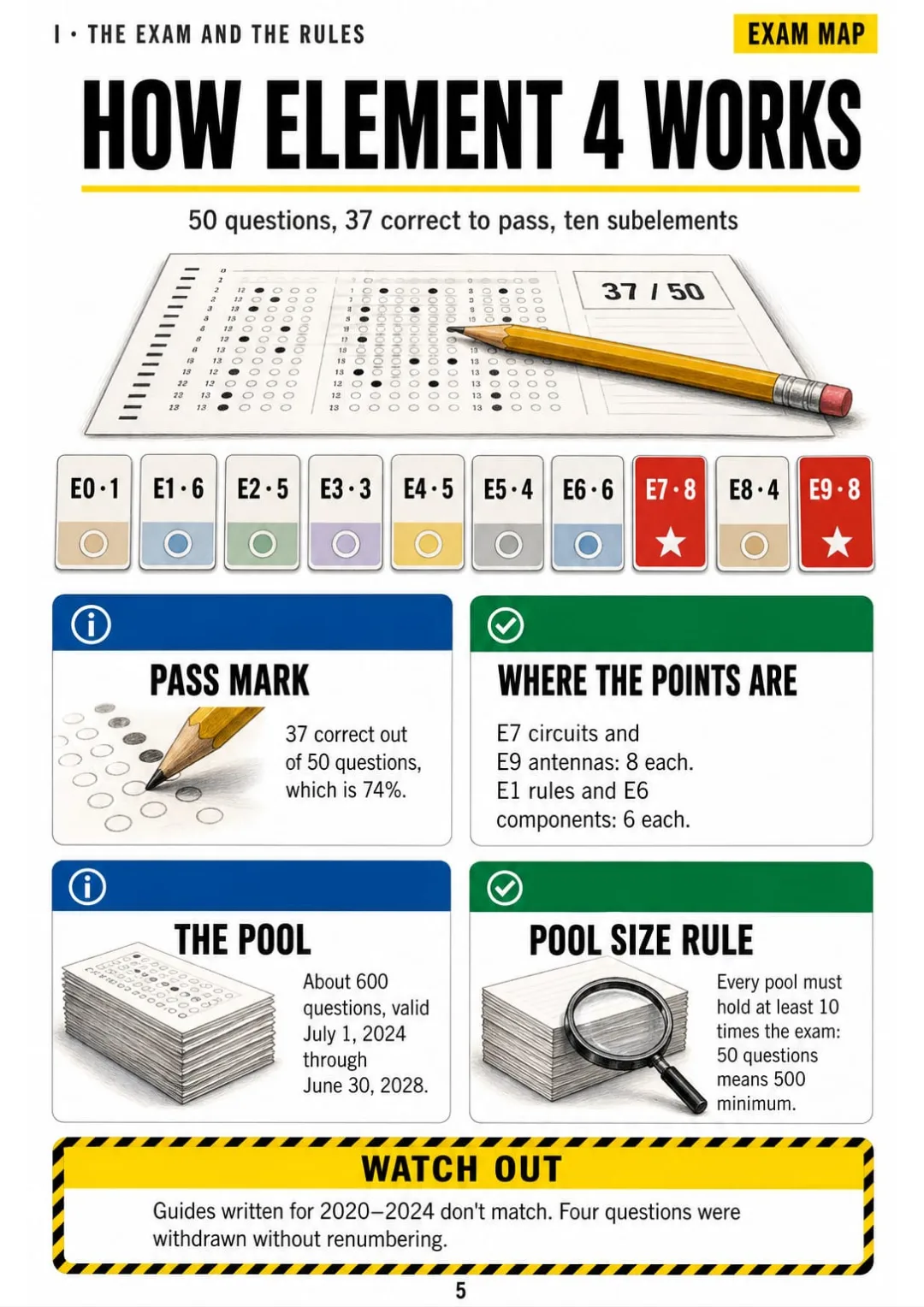
50 questions, 37 to pass: E7 and E9 carry 8 questions each.
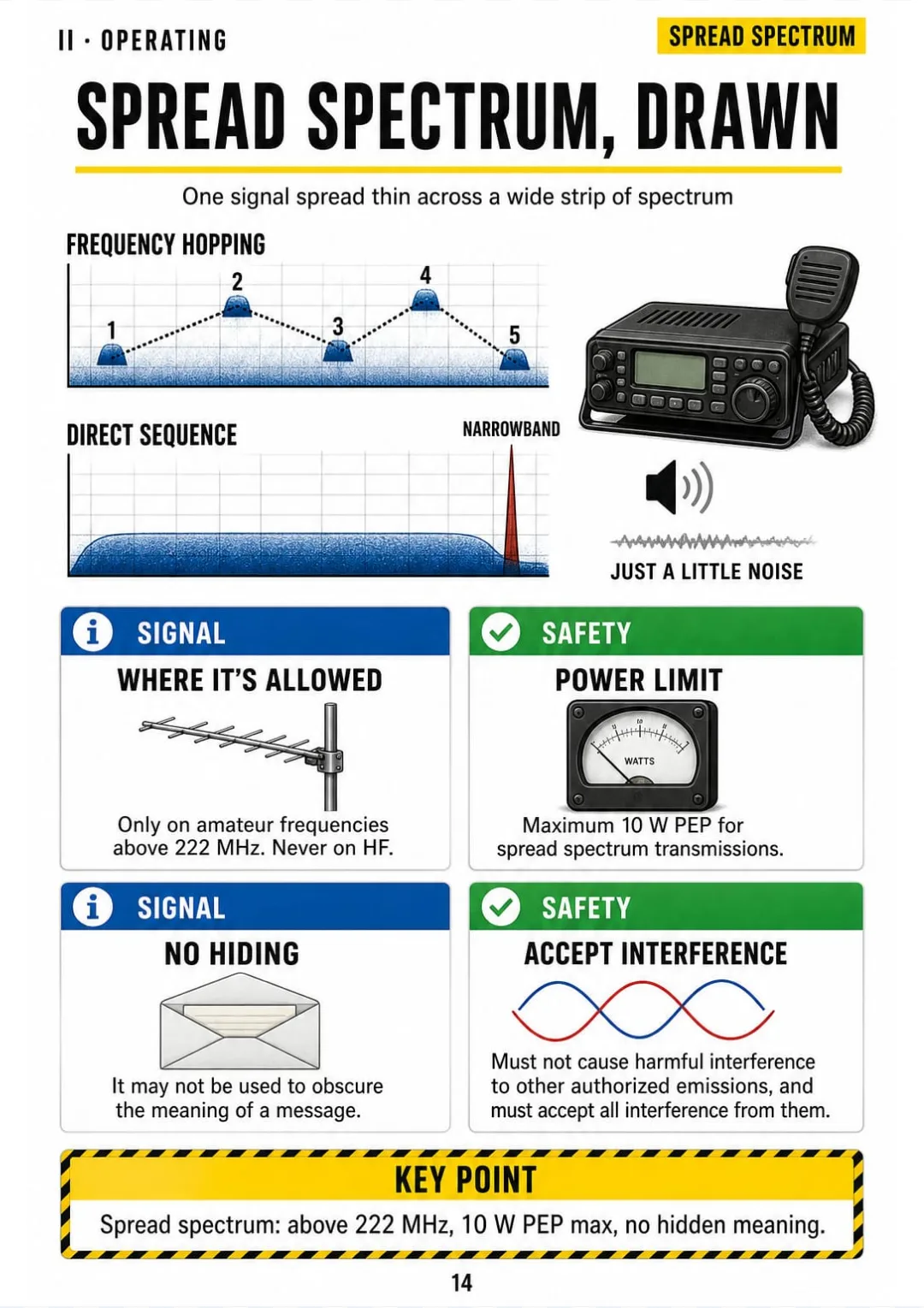
Spread spectrum: only above 222 MHz, 10 W PEP maximum, never to hide a message.
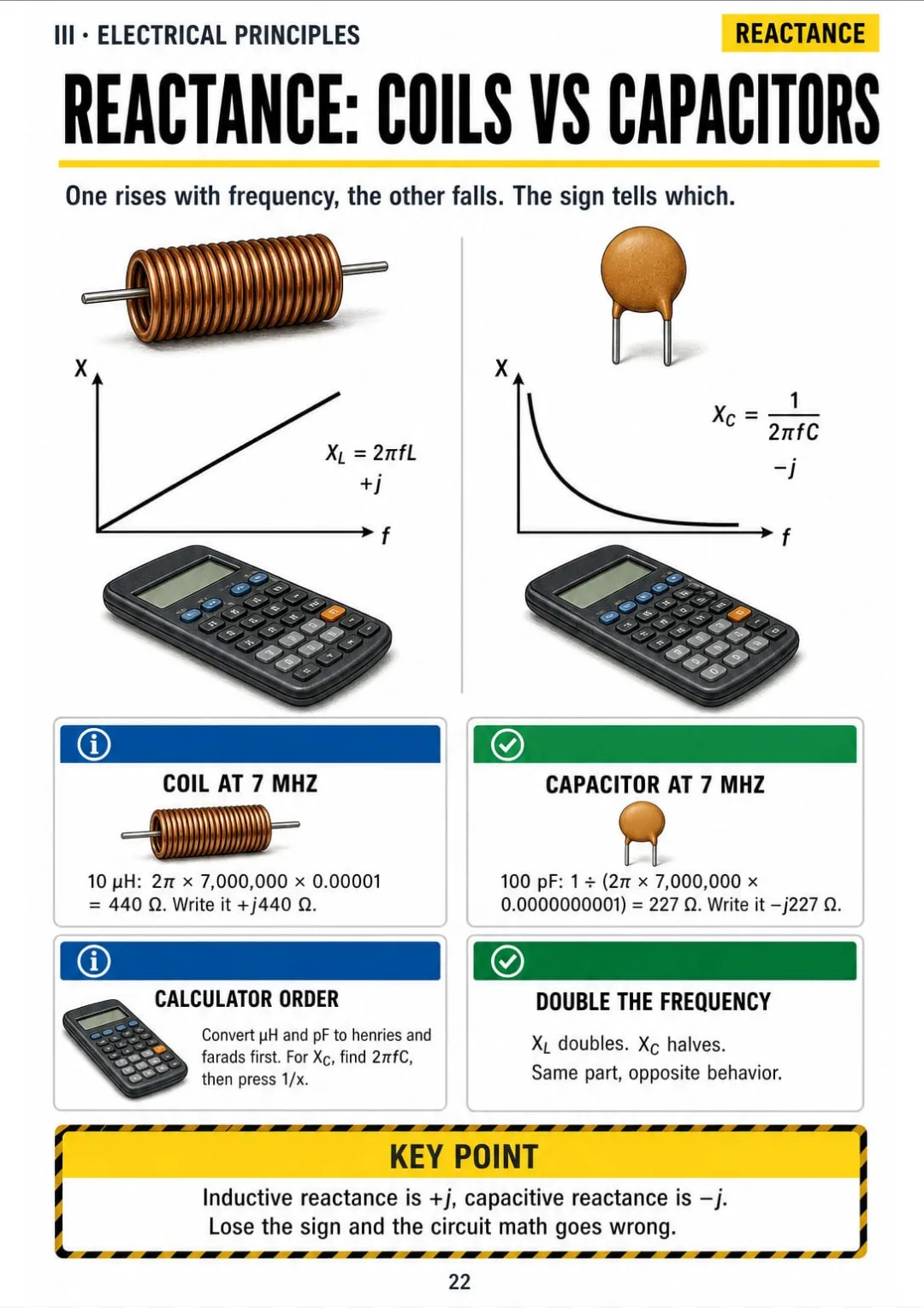
XL = 2πfL rises (+j), XC = 1/(2πfC) falls (−j): 10 µH = +j440 Ω, 100 pF = −j227 Ω at 7 MHz
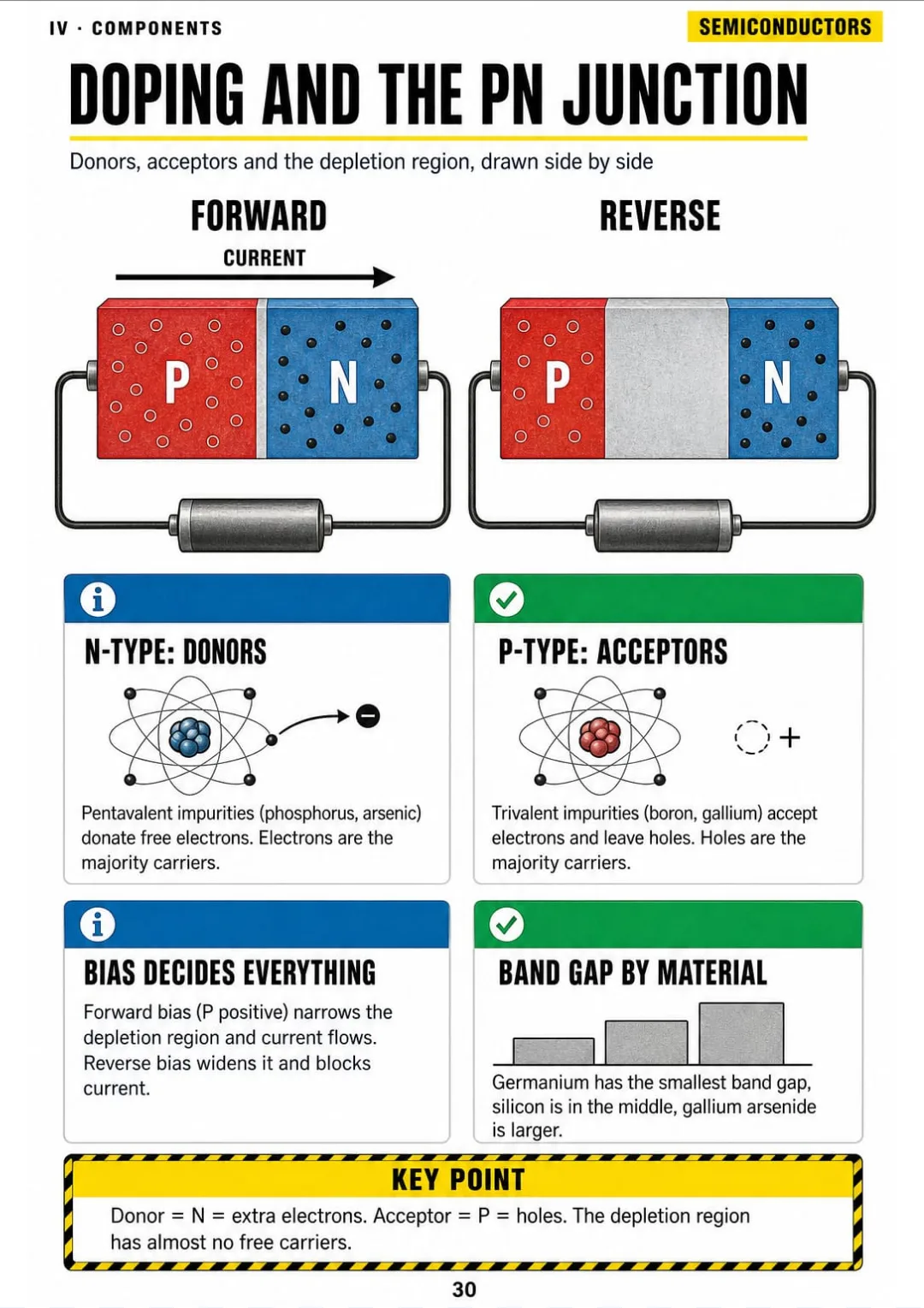
N-type gets donors, P-type gets acceptors; forward bias narrows the depletion region, reverse bias widens it.
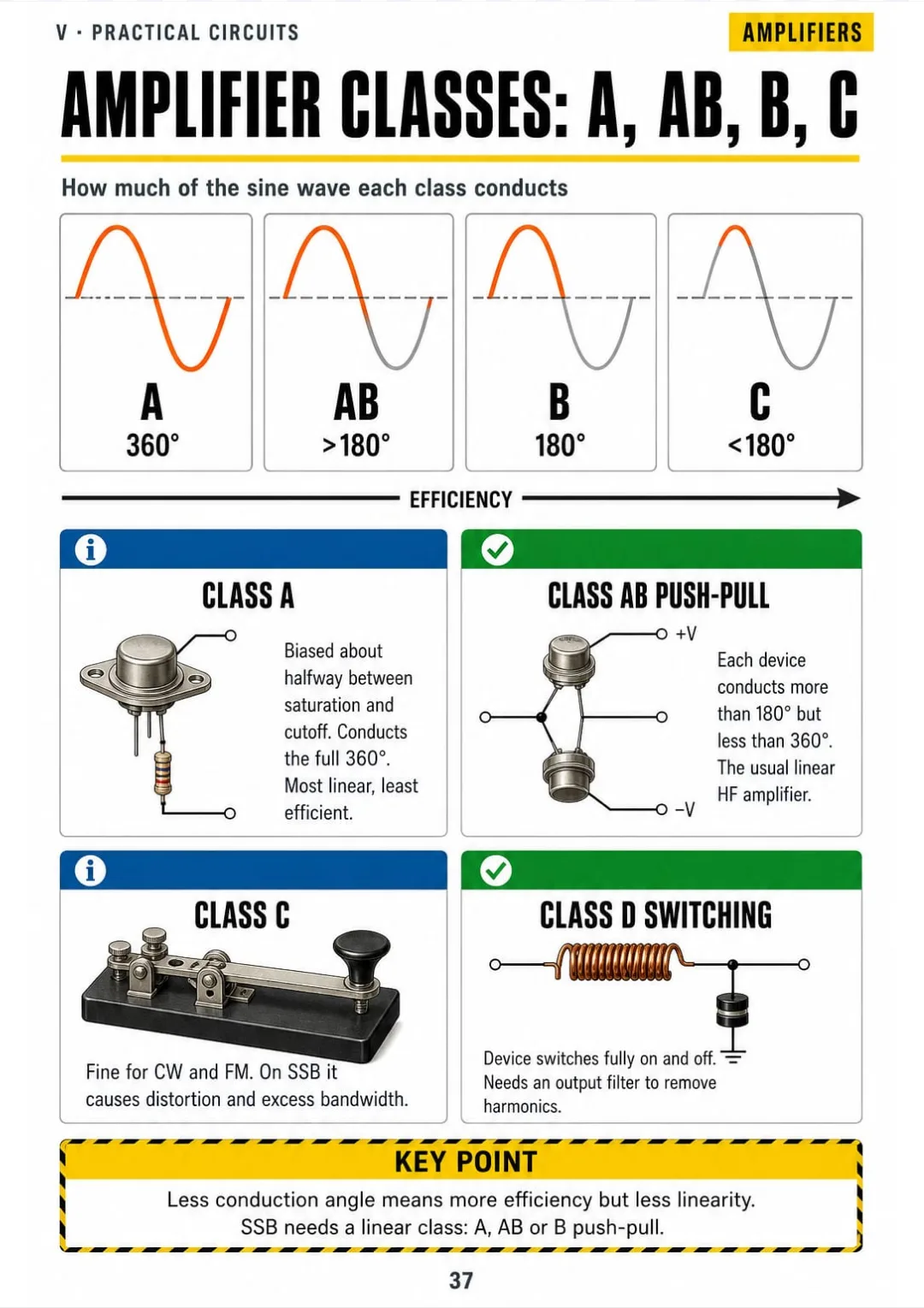
Class A 360°, AB between 180° and 360°, B 180°, C under 180°: and why C ruins SSB.
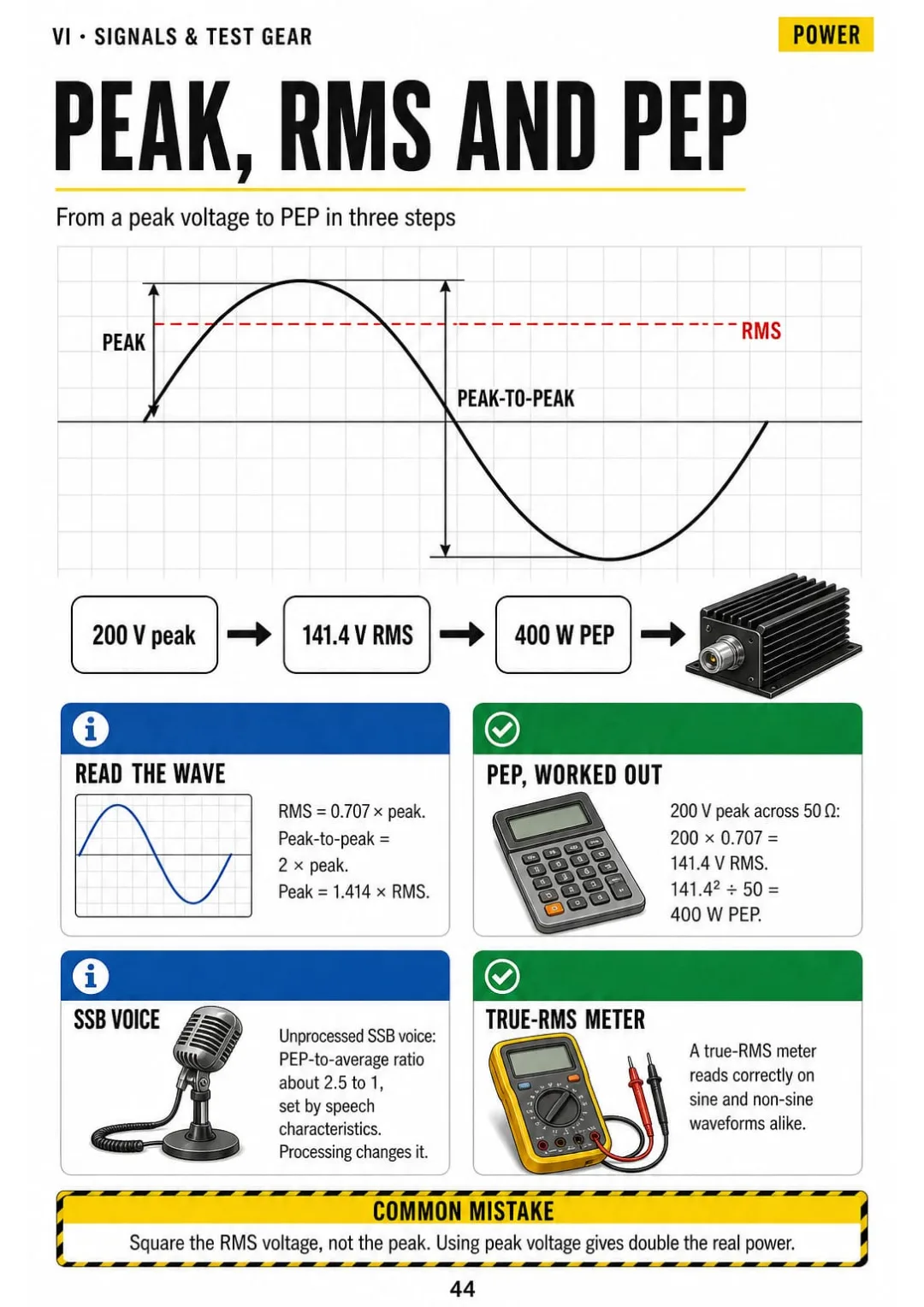
200 V peak across 50 Ω → 141.4 V RMS → 400 W PEP
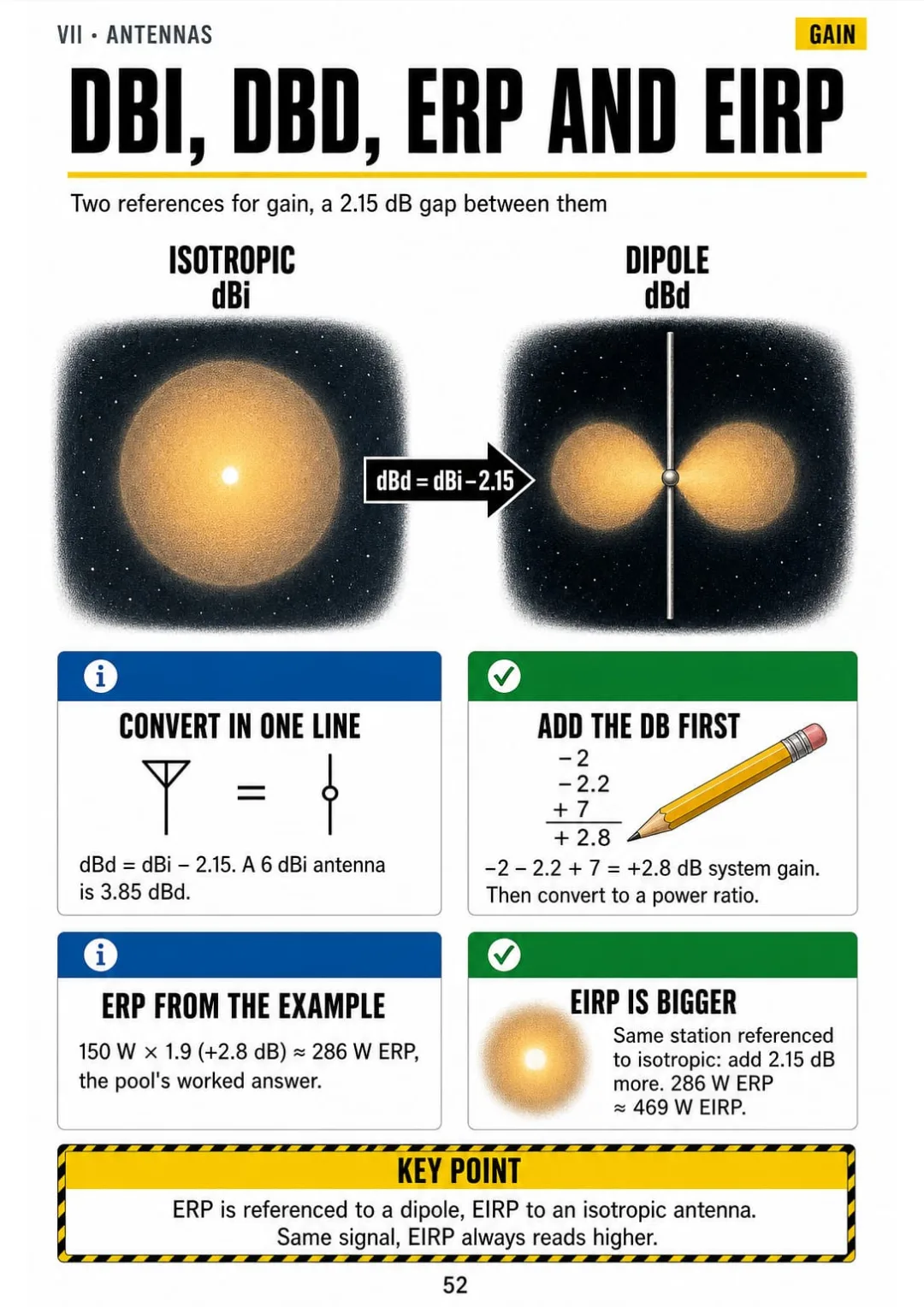
150 W, −2 dB, −2.2 dB, +7 dBd = 286 W ERP, one step per line
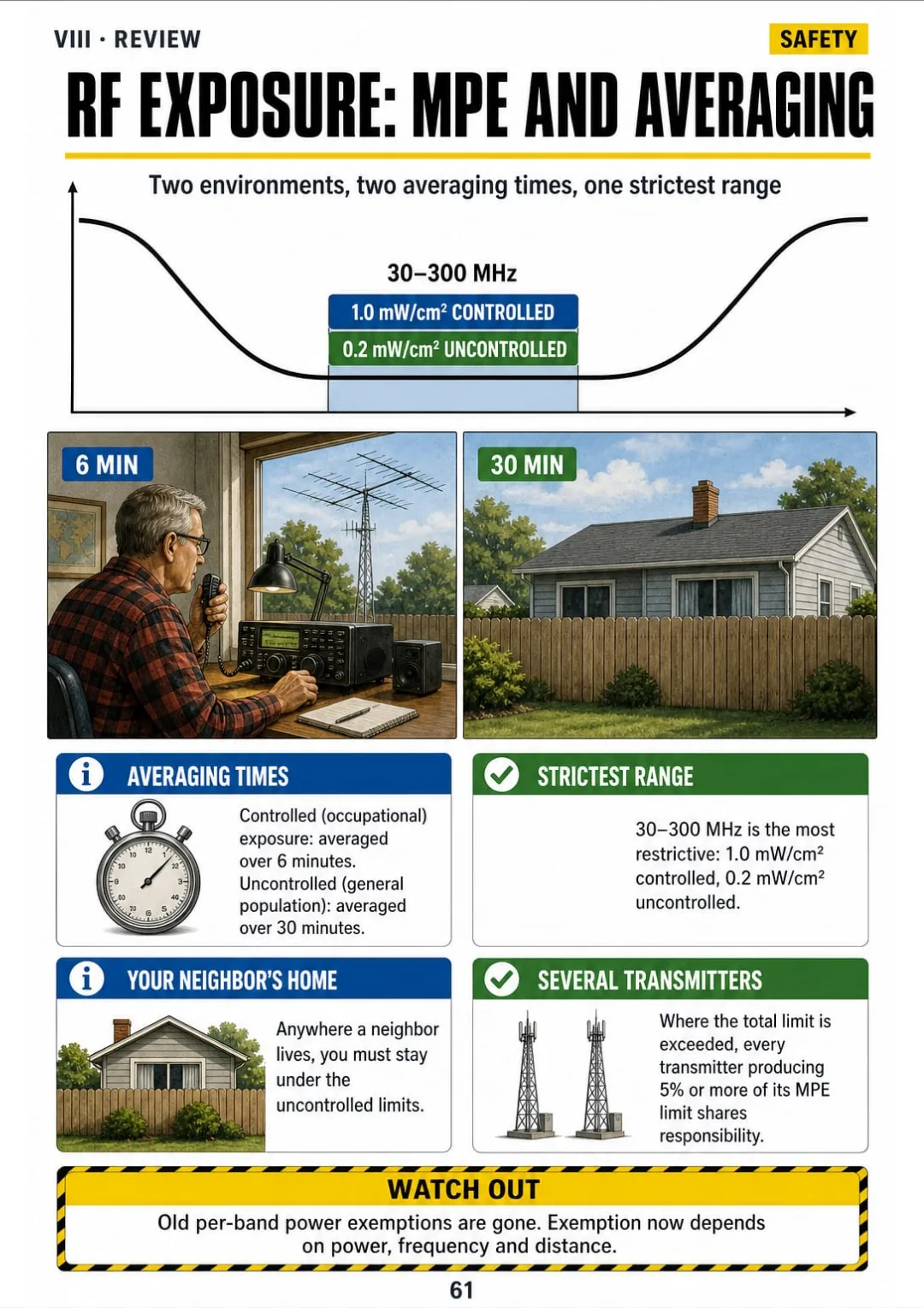
MPE averaging: 6 minutes controlled, 30 minutes uncontrolled; 30–300 MHz is strictest.

Swipe to see more →

These are real pages from the book. The table of contents is the full one: 8 parts and 61 topics.

The Problem Isn't You. It's How It Was Explained to You.

You're on a practice question: the reactance of a 10 µH coil at 7 MHz. You remember there's a 2π in it. Plus or minus? You're not sure.

The manual gives you XL in one paragraph, XC in the next, then phase angles and the j operator. Nobody shows you why one goes up and the other goes down.

XL = 2πfL rises (+j), XC = 1/(2πfC) falls (−j): 10 µH = +j440 Ω, 100 pF = −j227 Ω at 7 MHz

In the book, reactance is one page. The coil on the left, its line rising with frequency, marked +j. The capacitor on the right, falling, marked −j. Underneath, the same 7 MHz example worked out: 10 µH is +j440 Ω, 100 pF is −j227 Ω.

Resonance, amplifier classes, PEP, ERP and the Smith chart get the same treatment: one page each, drawing on top.

You picture the two curves and the sign takes care of itself. When the exam turns the question around, you work it out without going back to the manual.

COMPARE FOR YOURSELF

Same Topic, Two Ways to Study It

THIS
  • The manual: line after line
  • Spread spectrum rules explained only in words
  • You walk into the session still unsure
Spread spectrum is a family of emission techniques in which the signal energy is distributed across a bandwidth considerably wider than the information itself requires. Amateur use is limited to certain higher-frequency allocations and subject to a maximum output figure, with further conditions concerning identification, the purpose of the transmission and the techniques that may be employed. Frequency hopping and direct sequence are the two approaches most often described, and the operator must remain aware of every applicable limitation, as well as the station's ongoing responsibilities, whenever these emissions are in use.
FOR THIS
  • Spread spectrum in one drawing
  • The 222 MHz and 10 W limits in a box
  • You see it and it makes sense
Spread spectrum: only above 222 MHz, 10 W PEP maximum, never to hide a message.
CONTENTS

Take a Look at the 8 Parts and 61 Topics

The exam and the rules, operating and propagation, electrical principles, components, practical circuits, signals and test gear, antennas and the Smith chart, and a final review before the session: 65 pages, all illustrated.

IThe Exam and the Rules · pp. 5-13
  1. How Element 4 Works
  2. Your Extra Segments on the Band Chart
  3. 60 Meters: Channels, Not a Band
  4. 2200 m and 630 m: The LF and MF Bands
  5. Space Stations, Telecommand and Earth Stations
  6. Remote, Automatic and Auxiliary Control
  7. Volunteer Examiners and the Session
  8. Operating Abroad and Third-Party Traffic
  9. Interference, Quiet Zones and Antenna Height
IIOperating and Propagation · pp. 14-21
  1. Spread Spectrum, Drawn
  2. Digital Modes on One Page
  3. Contests, DX Pileups and Split Operation
  4. Satellites and Doppler
  5. Earth-Moon-Earth (EME)
  6. Meteor Scatter and Sporadic E
  7. Gray Line, Long Path and Transequatorial
  8. Solar Indices: SFI, A and K
IIIElectrical Principles · pp. 22-29
  1. Reactance: Coils and Capacitors
  2. Resonance in One Picture
  3. Q and Bandwidth
  4. Time Constants: 63.2 Percent
  5. Impedance in Rectangular and Polar Form
  6. Phase: Who Leads, Who Lags
  7. Real Power, Reactive Power and Power Factor
  8. Skin Effect, Fields and Admittance
IVComponents · pp. 30-36
  1. Doping and the PN Junction
  2. Special Diodes: PIN, Schottky, Varactor, Zener
  3. Bipolar Transistors: Alpha, Beta and Cutoff
  4. FETs and MOSFETs
  5. The Op Amp, Ideal and Real
  6. Toroids, Ferrites and Core Material
  7. Crystals, Opto-isolators, Solar Cells and Logic
VPractical Circuits · pp. 37-43
  1. Amplifier Classes A, AB, B and C
  2. Neutralization and Amplifier Stability
  3. Filters: Butterworth, Chebyshev, Elliptic
  4. Oscillators: Colpitts, Hartley, Pierce
  5. Mixers and the Superhet
  6. DSP and Software-Defined Radio
  7. Power Supplies and Regulators
VISignals, Modulation and Test Gear · pp. 44-51
  1. Peak, RMS and PEP
  2. Fourier: Every Wave Is Sine Waves
  3. Sampling and Nyquist
  4. Emission Designators and Modulation
  5. Oscilloscope and Spectrum Analyzer
  6. Counters, Time Base and the Vector Network Analyzer
  7. Receiver Specs: Noise Floor, Dynamic Range, IMD
  8. Noise and Interference Hunting
VIIAntennas, Feed Lines and the Smith Chart · pp. 52-60
  1. dBi, dBd, ERP and EIRP
  2. Radiation Resistance and Efficiency
  3. Patterns: Beamwidth and Front-to-Back
  4. Phased Arrays and Yagis
  5. Receiving Antennas: Beverage, Loops, RDF
  6. Matching: Gamma, Stubs and Baluns
  7. Feed Lines and Velocity Factor
  8. Stubs: Open, Shorted, Quarter and Half
  9. Reading the Smith Chart in 4 Steps
VIIIReview Before the Session · pp. 61-65
  1. RF Exposure: MPE and Averaging Time
  2. Every Formula on One Page
  3. dB Without Fear
  4. Frequent Mix-Ups, Side by Side
  5. Your Last-Week Checklist

One Page, One Topic, All Clear

Think of it this way:

It's the night before your VE session. A practice question gives you 150 watts, two feed line losses and an antenna gain in dBd, and asks for the ERP.

You open the ERP page and follow the chain drawn from the transmitter to the antenna: −2 dB, −2.2 dB, +7 dBd, one step per line, until you land on about 286 W ERP. The next day, at the table, you picture that chain.

Class A 360°, AB between 180° and 360°, B 180°, C under 180°: and why C ruins SSB.

Same with your Extra band segments, resonance, amplifier classes, the Smith chart and RF exposure averaging: each one on its own page.

Amateur Extra Exam Illustrated is 65 illustrated pages in 8 parts, and it ends with a review section: every formula on one page, dB without fear, frequent mix-ups side by side and a last-week checklist.
What you see drawn, you don't have to memorize.

What's Inside Amateur Extra Exam Illustrated:

Ipp. 5-13

The Exam and the Rules

How Element 4 works, your Extra segments on the band chart, 60 meter channels, the LF bands, space and remote operation, volunteer examiners, operating abroad and interference rules.

IIpp. 14-21

Operating and Propagation

Spread spectrum, digital modes, contests and split operation, satellites and Doppler, EME, meteor scatter, gray line and the solar indices.

IIIpp. 22-29

Electrical Principles

Reactance, resonance, Q and bandwidth, time constants, impedance in rectangular and polar form, phase, power factor and skin effect.

IVpp. 30-36

Components

Doping and the PN junction, special diodes, bipolar transistors, FETs, the op amp, toroids and ferrites, crystals and logic.

Vpp. 37-43

Practical Circuits

Amplifier classes, neutralization, filters, oscillators, mixers and the superhet, DSP and SDR, power supplies and regulators.

VIpp. 44-51

Signals, Modulation and Test Gear

Peak, RMS and PEP, Fourier, sampling, emission designators, the scope and spectrum analyzer, the VNA, receiver specs and noise hunting.

VIIpp. 52-60

Antennas, Feed Lines and the Smith Chart

dBi, dBd, ERP and EIRP, radiation resistance, patterns, phased arrays and Yagis, receiving antennas, matching, feed lines, stubs and the Smith chart in 4 steps.

VIIIpp. 61-65

Review Before the Session

RF exposure and averaging time, every formula on one page, dB without fear, frequent mix-ups side by side and your last-week checklist.

At the end of the book: Every formula on one page, dB without fear, frequent mix-ups side by side and a last-week checklist.
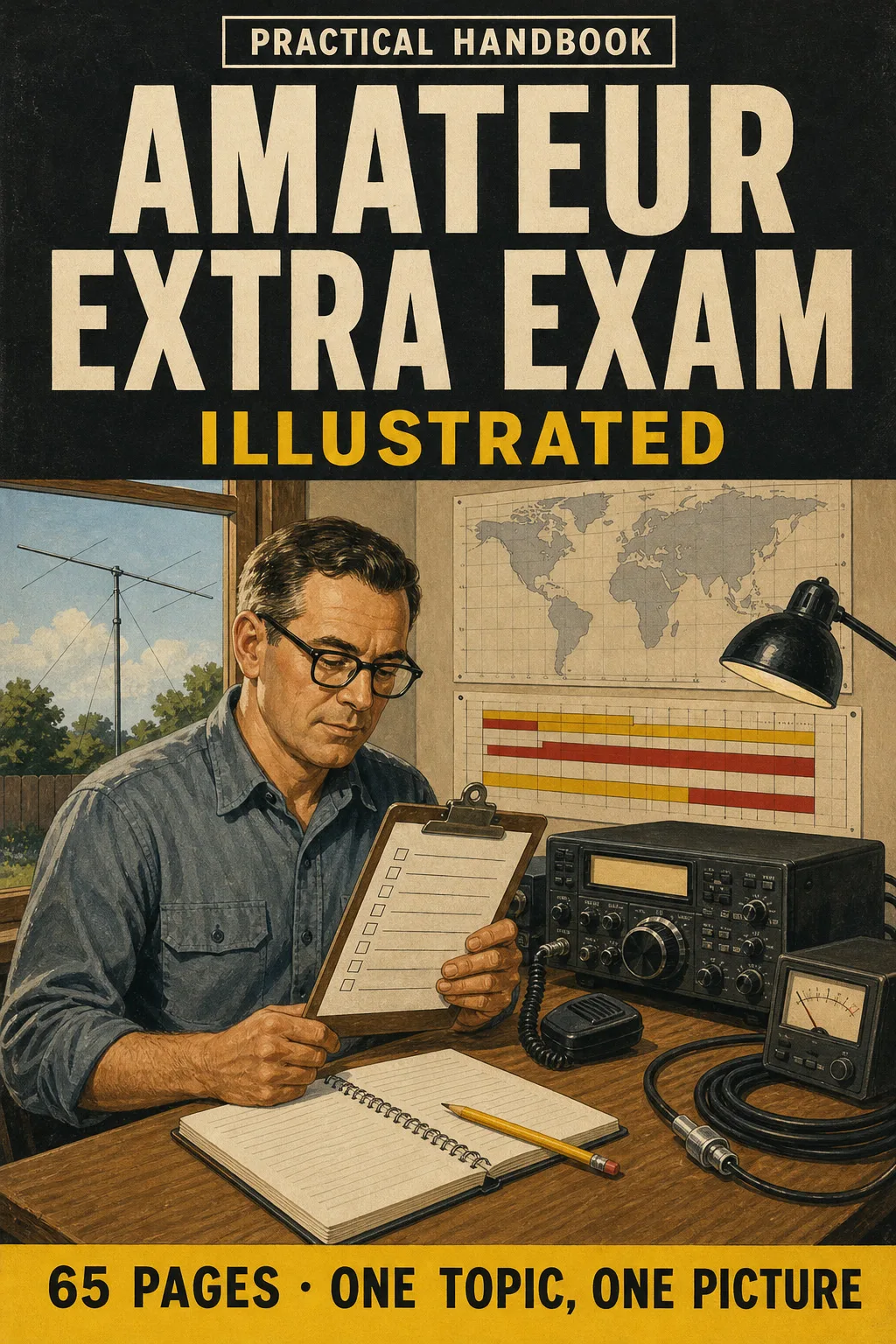
Plus: 2 Free Books

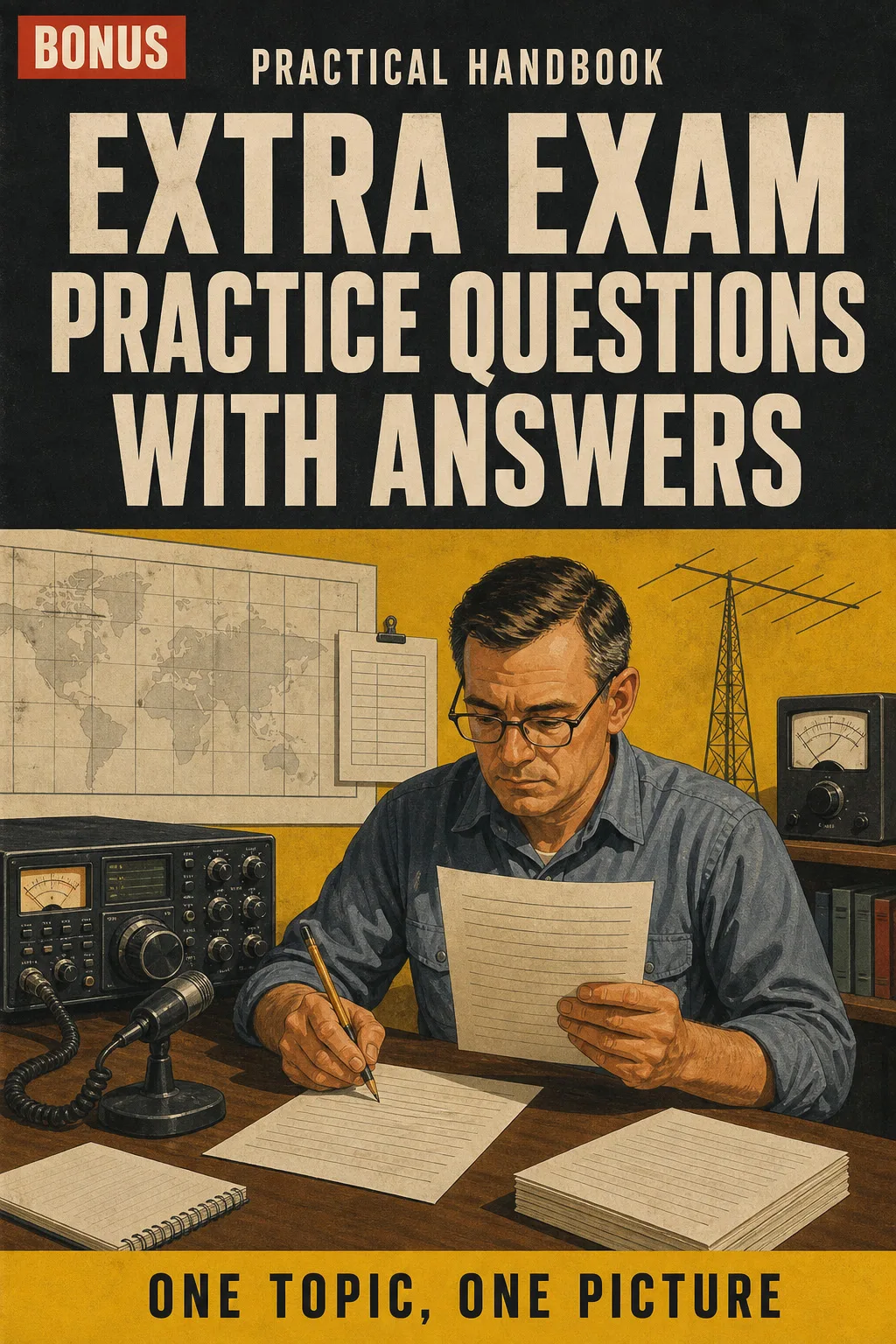
Extra Exam Practice Questions with Answers

BONUS 1: «Extra Exam Practice Questions with Answers»

Value on its own: US$ 17.90

Test yourself topic by topic with exam-style questions, and see why each right answer is right.

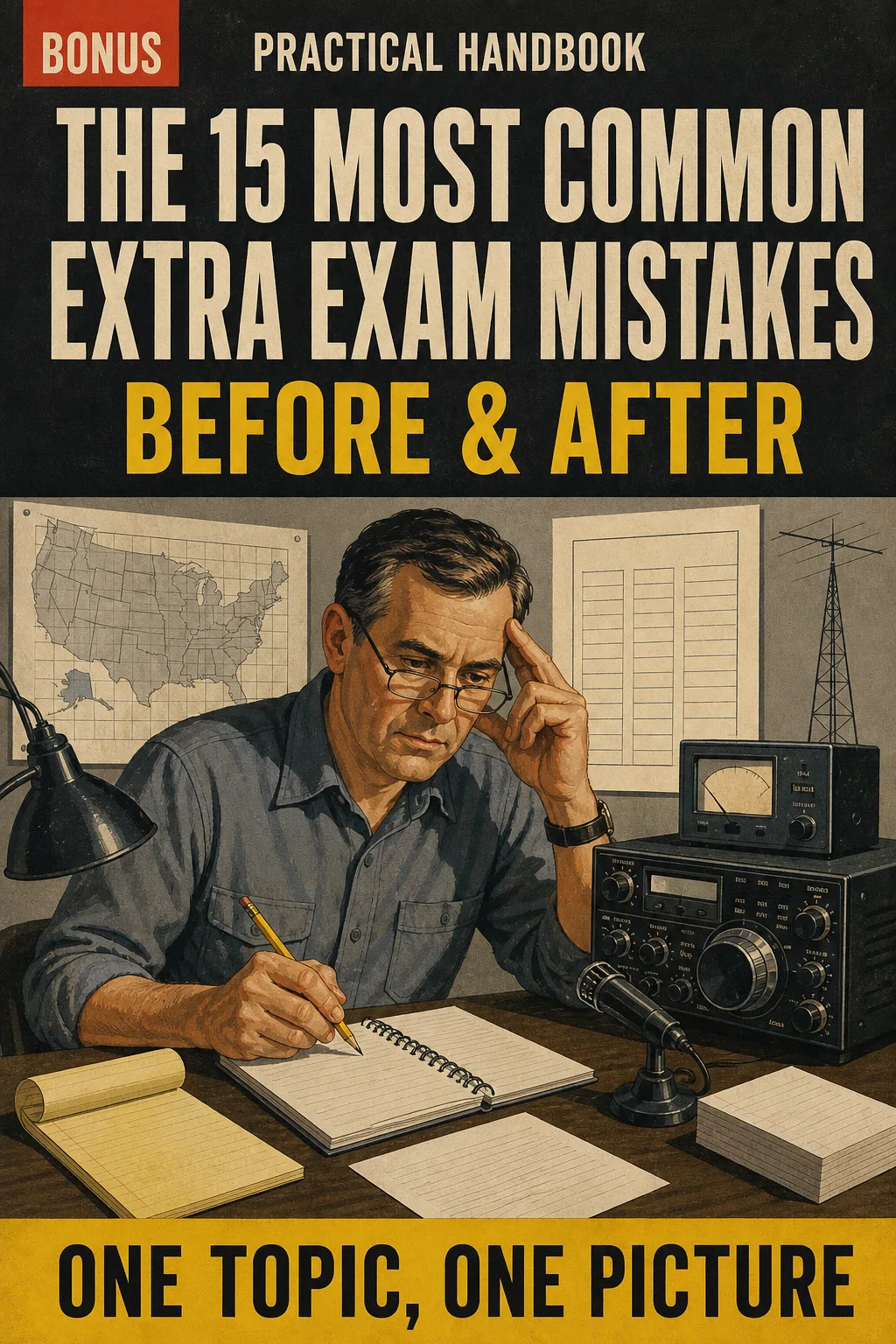
The 15 Most Common Extra Exam Mistakes: Before & After

BONUS 2: «The 15 Most Common Extra Exam Mistakes: Before & After»

Value on its own: US$ 14.90

Spot the mix-ups that trip people up most often (like reactance signs or band edges) and see the correct way, side by side.

Amateur Extra Exam Illustrated with 2 Free Books

  • Amateur Extra Exam Illustrated: 65 illustrated pagesUS$ 63
  • BONUS 1: Extra Exam Practice Questions with AnswersUS$ 17.90
  • BONUS 2: The 15 Most Common Extra Exam Mistakes: Before & AfterUS$ 14.90
  • High-resolution PDF to printIncluded
Total value US$ 95.80
YOUR PRICE:
US$ 27
You save US$ 68.80
YES, I WANT AMATEUR EXTRA EXAM ILLUSTRATED FOR US$ 27

📄 This is a digital PDF book sent to your email: nothing is printed or shipped.

Secure purchaseEncrypted payment30-day guarantee

PDF by email: We email you Amateur Extra Exam Illustrated as a PDF, together with the two free books. It's a single payment: no installments, no extra charges.

Who This Book Is For

You're studying for Extra

You're studying for Extra

Instead of hundreds of loose pool questions, you get the picture behind each group of them, so the answer still makes sense when the wording changes.

Your VE session is coming up

Your VE session is coming up

The review section puts every formula, the band edges and the frequent mix-ups in a few pages you can go over the week before.

You already operate HF

You already operate HF

Print the band chart, the dB page and the Smith chart steps and keep them next to the rig for the day you work the Extra segments.

Everything You Get Today

US$ 95.80US$ 27
YES, I WANT AMATEUR EXTRA EXAM ILLUSTRATED FOR US$ 27

📄 This is a digital PDF book sent to your email: nothing is printed or shipped.

30DAYS
GUARANTEE

30-Day Guarantee

Try Amateur Extra Exam Illustrated for 30 days, bonus books included.

We refund everything if the file won't open, if the book isn't what you see here, if you were charged twice or if the email doesn't arrive. Just email us.

You pay once. No subscriptions.

Frequently Asked Questions

Is it for me if I hold a General license and I'm not an engineer?

Yes. It's written for General licensees moving up to Extra. The math is worked step by step on the page, with the numbers shown, and nothing is taken for granted.

Where does the content come from?

From the current Amateur Extra (Element 4) question pool, valid July 1, 2024 to June 30, 2028, and the FCC amateur rules in 47 CFR Part 97. If you take Element 4 before June 30, 2028, this is the pool your exam is drawn from.

Is it official material?

No. It's an independent illustrated study guide, not published or endorsed by the FCC, the NCVEC, the ARRL or any VEC. It doesn't give you a license or exam credit: you still take Element 4 at a VE session.

I already have the free question pool and a flashcard app. What does the book add?

The pool and the apps drill the answer. The book shows the picture behind each group of questions: the two reactance curves, the ERP chain, the conduction angle of each amplifier class. When the wording changes, you work it out instead of trying to remember it. Keep using the pool and your app. The book is the visual companion next to them, not a replacement for a course or your club's classes.

Are the practice questions the ones on the exam?

No. The practice questions are written for this book, in exam style, to check that you can work the reasoning, not just recognize an answer. The real exam questions come from the public pool: keep drilling it alongside the book.

When and how do I get it?

The book and the 2 bonus books arrive as a PDF by email, at the address you enter at checkout.

Do I have to pay every month?

No. It's a one-time payment. No subscription.

Can I have it on paper?

It comes as a PDF only: nothing is shipped. You can print it at home or at a print shop and keep the pages you use most, like the band chart and the formula page, next to the radio.

How does the refund work?

You have 30 days. We refund everything if the file won't open, if the book isn't what you see on this page, if you were charged twice or if the email doesn't arrive: just email us.

Before You Close This Page

No more rereading the pool with nothing sticking.

Reactance, resonance and ERP: you see them drawn and you've got them.

You walk into the session knowing where everything is.

Drawings make studying faster.

The book is right below.

One-time payment: US$ 27 · Guarantee: 30 days · PDF by email

YES, I WANT AMATEUR EXTRA EXAM ILLUSTRATED FOR US$ 27

📄 This is a digital PDF book sent to your email: nothing is printed or shipped.